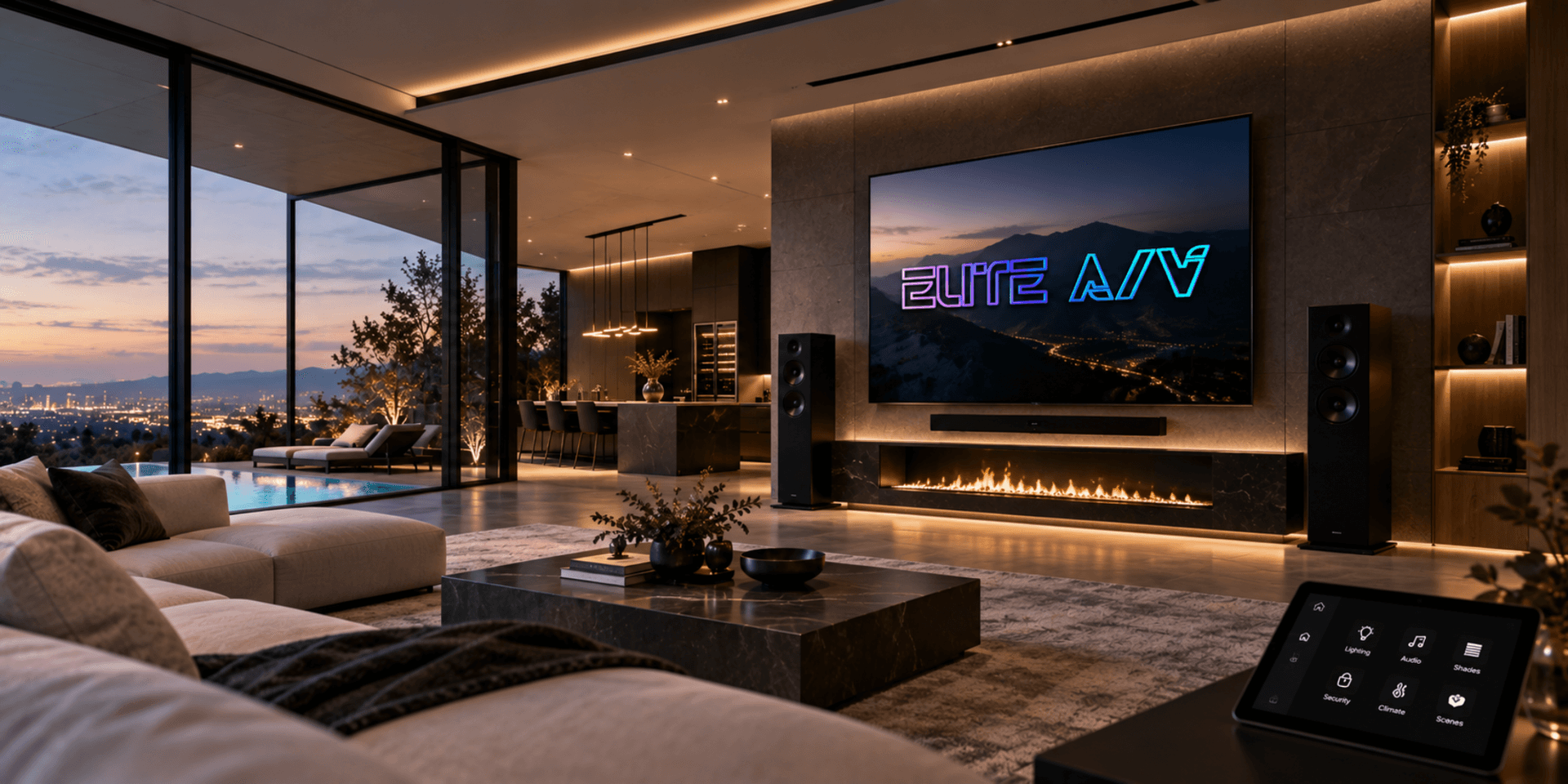
The most sophisticated smart homes are not defined by how much technology homeowners can see, but by how naturally everything works together behind the scenes.
There is a point when smart-home technology stops feeling impressive.
It happens when the homeowner stops thinking about it.
The lights settle into the right setting. The shades adjust with the day. Music moves naturally throughout the home. The network supports dozens of connected systems without drawing attention to itself. Security, climate, entertainment, and automation simply work in the background.
For Elite A/V | Smart Home & Automation Integration, that absence of friction is not a lack of technology.
It is the clearest sign that the technology was designed correctly.
The New Definition of Luxury Smart Home Integration
Founder and CEO Jeremy Degre has worked in custom electronics and residential technology since 1998. Over that time, the definition of a smart home has changed dramatically.
What once meant a few automated devices can now include lighting control, motorized shades, surveillance, access control, entertainment, networking, distributed audio, climate systems, and whole-home automation operating simultaneously.
The challenge is no longer simply adding technology.
It is making all of those systems feel like one environment.
Elite A/V approaches technology as part of the home's underlying architecture rather than as a collection of individual products.
That distinction matters.
When systems are planned separately, homeowners can inherit multiple apps, duplicated controls, conflicting routines, and technology that constantly demands attention.
When they are designed as one coordinated system, complexity can disappear from the homeowner's experience.
“Luxury technology should feel effortless,” Degre says. “But behind that simplicity is an incredible amount of planning. The homeowner should not have to understand how complicated the system is in order to enjoy it.”
The Most Important Technology May Be Behind the Walls
A beautiful touchscreen, private theater, or hidden speaker system may get the attention, but much of a smart home's performance begins somewhere far less visible.
It begins with infrastructure.
Structured wiring, networking, equipment locations, power management, documentation, and system design determine whether a connected home remains reliable long after installation.
Elite A/V evaluates those fundamentals before layering individual technologies into the property.
That is especially important as modern luxury homes become increasingly dependent on connectivity.
Streaming video, surveillance cameras, mobile devices, automation processors, lighting systems, televisions, door stations, and countless other connected devices may all rely on the same network.
A weak network can therefore affect far more than internet browsing.
It can affect the experience of the entire home.
Elite A/V treats networking as critical infrastructure rather than an accessory. Routers, managed switches, wireless access points, equipment racks, and remote service capabilities are planned as part of the larger system.
Once that foundation is established, lighting, audio, video, security, climate, and automation can operate more predictably together.
Fewer Apps. Better Experience.
The modern homeowner has access to thousands of connected products.
Many of them are excellent.
The problem is that excellent individual products do not automatically create an excellent system.
A homeowner may have one app for lighting, another for shades, another for music, another for cameras, another for climate, and another for the garage door.
Technically, everything may be “smart.”
The experience can still feel fragmented.
Professional integration is about reducing that friction.
Systems such as Control4 and Crestron can bring multiple technologies into a unified control experience so homeowners are not constantly jumping between unrelated interfaces.
The goal is not to eliminate every manufacturer application or force every product into a single screen.
The goal is to make the home easier to live with.
That may mean a single routine that adjusts lighting, shades, climate, and entertainment at the end of the evening rather than asking the homeowner to manage each system individually.
When the House Learns to Stay Out of the Way
Consider something as ordinary as coming home at the end of the day.
In a conventional house, a homeowner may adjust several lights, close shades, change the thermostat, turn on music or television, check security, and make other small adjustments one at a time.
In a thoughtfully integrated home, many of those actions can become part of a coordinated routine.
Architectural lighting can create scenes for entertaining, relaxing, dining, or nighttime use.
Motorized shades can help manage privacy and sunlight.
Climate can respond to schedules and occupancy.
Entertainment can be available without navigating multiple remotes or applications.
Outdoor areas can extend the same experience with landscape audio, outdoor television, Wi-Fi, lighting, and control.
The luxury is not that any one of those technologies exists.
The luxury is that the homeowner does not have to manage each one separately.
Technology Should Complement the Architecture
Luxury integration is also becoming increasingly architectural.
Homeowners, builders, architects, and designers often want the benefits of technology without allowing it to dominate the appearance of the home.
That can mean televisions that blend into a room, architectural speakers that disappear into ceilings or walls, centralized equipment racks, hidden wiring, discreet cameras, motorized shades integrated into window treatments, and keypads that replace rows of conventional switches.
The technology is still powerful.
It simply does not need to announce itself.
That philosophy is especially important in high-end homes where interior design, architecture, and technology must coexist.
The best result is not a room filled with gadgets.
It is a room that functions beautifully while preserving the designer's original intent.
Serviceability Is Part of the Design
Luxury technology is often judged by what it can do on the day it is installed.
Elite A/V believes an equally important question is what happens years later.
Internet providers change. Streaming platforms update. Televisions are replaced. Manufacturers release new products. Families remodel rooms, add outdoor spaces, or change the way they use their homes.
A well-designed system should be able to evolve without requiring the entire property to be reinvented.
That is why equipment racks, labeling, documentation, wiring standards, network architecture, and remote-service capabilities matter.
The goal is not merely to make technology work once.
It is to make it understandable, maintainable, and expandable over time.
Experience Changes the Way Technology Is Selected
Degre's perspective comes from nearly three decades in custom electronics and integrated technology.
His professional background includes CEDIA certifications covering infrastructure, integrated systems, residential networking, and electronic systems design, along with training and certifications from THX, the Imaging Science Foundation, and the Home Acoustics Alliance.
Elite A/V also operates as a licensed Nevada low-voltage contractor with burglar alarm and security licensing.
That experience influences how products are selected.
New does not automatically mean better.
The newest device may have impressive features, but a professional integrator must also consider reliability, compatibility, serviceability, long-term manufacturer support, and how the product fits into the rest of the home.
Anyone can add another device.
Creating a system in which many different technologies behave like one environment requires a much deeper level of planning.
A Smart Home Should Still Feel Like a Home
The real test of luxury smart-home integration is not how impressive the equipment rack looks or how many features appear on a specification sheet.
It is what happens months and years later.
Can the family use the system without thinking about it?
Can guests understand the lighting?
Does entertainment start without a troubleshooting ritual?
Does Wi-Fi remain dependable throughout the property?
Can technology be upgraded without rebuilding everything?
Those questions reveal the difference between owning connected products and living in a genuinely integrated home.
For Elite A/V, the process begins before installation.
It begins with understanding the property, its architecture, its infrastructure, and the routines of the people who will live there.
Technology follows that understanding rather than dictating it.
That may be the most meaningful evolution in luxury home automation.
The industry's most sophisticated work is becoming less about putting technology on display and more about making it disappear into the experience.
For more information about Elite A/V | Smart Home & Automation Integration, visit HomeTheater.Vegas.

Best Houses Contributor
Covers proptech and housing data, and the tools changing how homes are bought, sold, and financed.
This article features partner, contributor, or branded content from a third party. Members of the Best Houses editorial staff were not involved in the creation of this content. All views and opinions are those of the contributor alone.